
Understanding hymn tunes and meter
Make sense of the names and numbers on a hymn page, then find a melody and begin singing.
Two details help you find the music for a hymn: its tune name, which identifies the melody, and its meter, the pattern of syllables in each stanza.
Pat Dys’s Psalm 1 poem from Heritage Psalter provides an example of how those details connect the printed words with a familiar melody.
Read the markings on a hymn page
On printed page 1 of Heritage Psalter, the suggested hymn appears beneath “Psalm 1,” while the tune name and meter appear at the foot of the page.
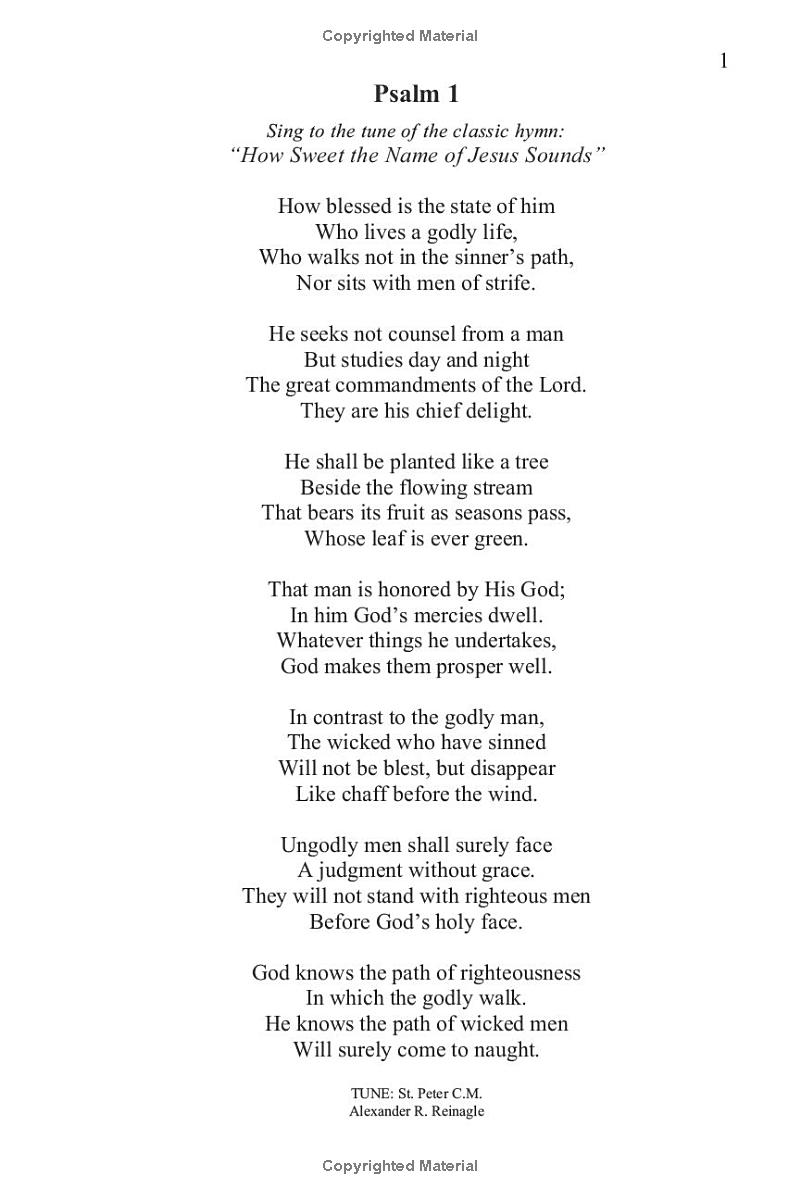
- “How Sweet the Name of Jesus Sounds”
- The suggested hymn provides a familiar reference for the melody.
- St. Peter
- The tune name to look for in a hymnal’s index.
- C.M.
- Common meter: four lines with 8, 6, 8, and 6 syllables.
Pat Dys, Heritage Psalter, page 1. Select the page to view it at full size.
One melody can carry several hymn texts, and a single text can be sung to different melodies. Searching by tune name is therefore more precise than searching by hymn title alone.
What is hymn meter?
In a hymnal’s metrical index, 8.6.8.6 means eight syllables in the first line, six in the second, eight in the third, and six in the fourth. This is the poem’s syllable pattern, distinct from musical rhythm or tempo.
The second line of Pat’s Psalm 1 poem shows the six-syllable pattern:
Who lives a godly life,
- Who
- lives
- a
- god
- ly
- life
Read the whole stanza aloud to check its pattern. Poetic pronunciation can affect the count: in the opening line, “blessed” takes two syllables, “bless-ed.”
What does C.M. mean?
C.M. means common meter: 8.6.8.6. The name is shorthand for a frequently used pattern. Once you recognize it, you can look in a hymnal’s metrical index for melodies with that pattern.
What do S.M., C.M., and L.M. mean?
These abbreviations describe a hymn’s poetic meter, the number of syllables in each line of a stanza. They help you use a metrical index, where tunes are grouped by their syllable patterns.
| Marking | Name | Syllables in each line |
|---|---|---|
| S.M. | Short meter | 6.6.8.6 |
| C.M. | Common meter | 8.6.8.6 |
| L.M. | Long meter | 8.8.8.8 |
A D means that the pattern is doubled. C.M.D. has eight lines following 8.6.8.6.8.6.8.6. In the Psalm 23 sample from Heritage Psalter, Duane Street is marked L.M.D.: eight lines of eight syllables.
How do you find a hymn by its tune name?
Look up St. Peter in your hymnal’s tune index. The Psalm 1 page credits Alexander R. Reinagle for this melody; that credit can help distinguish it from a tune with a similar name.
The OPC’s original Trinity Hymnal entry for “How Sweet the Name of Jesus Sounds” identifies St. Peter and provides a MIDI download link. It is hymn 544 in that collection; hymn numbers vary between hymnals. A MIDI file may need to be opened in a compatible music player.
Can any tune with the same meter be used?
Matching meter gives you a candidate, not a guarantee. The stresses in the melody need to suit the natural emphasis of the words. Refrains and repeated phrases also need attention. The Methodist Church’s guide to meter in hymnody explains these limits and recommends trying a substitution aloud.
Read the stanza naturally before singing it. Then try the melody and listen: are you placing a strong accent on the wrong syllable, rushing several words, or stretching a phrase until its meaning is hard to follow? Does the tune’s character suit what the text is saying? If the fit is awkward, return to the suggested tune or ask someone familiar with the hymnal to help.
What if you cannot read music?
Listen to the melody once, or ask a friend to sing it. Hum along before adding the words, then try one stanza slowly. Follow any refrain or repeat instructions that belong to the hymn.
If the melody you remember does not fit, check its tune name. A familiar hymn title may be sung to different melodies, so the title alone can lead you to the wrong one. Begin at a comfortable pitch when singing on your own. Reading the poem aloud remains a worthwhile way to spend time with it while you learn the music.
For a complete session with the example above, use our guide to singing Psalm 1. If you are working from Heritage Hymns, its tune and meter indexes can help you return to a melody. When the first task is finding words for a passage, begin with choosing a hymn for Scripture.